
Quick Answer — What Is Peanut Butter Manufacturing in India?
India is the world’s second-largest groundnut producer, growing over 9 million tonnes annually. Peanut butter manufacturing in India covers the full process of cleaning, roasting, grinding, blending, and packaging groundnuts into consumer or bulk peanut butter — governed by FSSAI standards, with growing demand from D2C fitness brands, retail chains, and export markets. This guide covers everything from manufacturing types to market opportunity.
₹950Cr+
Market Size 2025
India peanut butter
22%
CAGR
2022–2027 projected
9MT
Groundnut Output
India annually
~₹80
Raw cost / kg
vs $1.80 globally
What this guide covers
- Why India for peanut butter manufacturing
- Types of peanut butter
- Nutrition facts per 100g
- Step-by-step manufacturing process
- Quality standards — FSSAI, ISO, FDA
- Aflatoxin testing — why it matters
- Packaging formats & shelf life
- Market size & growth India 2025
- Private label vs white label explained
- How to launch your peanut butter brand
- How to export peanut butter from India
- Manufacturer selection checklist
- FAQ
Section 01 — Foundation
Why India Is the Natural Hub for Peanut Butter Manufacturing
India doesn’t just grow peanuts — it is the crop. Gujarat, Rajasthan, Andhra Pradesh, Tamil Nadu, and Karnataka together produce the bulk of the country’s groundnut yield, supplying raw material at a cost structure that no Western manufacturer can compete with. That supply chain advantage, combined with a rapidly growing domestic consumer base, makes India the most logical location to build or source a peanut butter brand today.
✦ Original Data — India Groundnut Advantage
India’s cost advantage is structural, not cyclical
When you compare ex-factory cost of natural peanut butter produced in India versus equivalent product from the USA or EU, Indian manufacturers consistently deliver 35–50% lower landed cost before freight. This gap persists because India grows groundnuts without significant import dependency on any input.
~₹80
India raw/kg
~₹145
USA equivalent
40%+
Cost gap
For brand builders, this means a private label peanut butter from an Indian manufacturer can enter retail shelves at a margin that simply isn’t achievable when sourcing from North America or Europe — even accounting for inbound logistics.
Section 02 — Product
Types of Peanut Butterx — Natural, Classic, Flavoured & Speciality
Not all peanut butter is the same. Understanding the four main product categories is the first decision any brand builder, retailer, or private label buyer needs to make — because the type determines your raw material, machinery, shelf life, target customer, and label compliance requirements.
🌿
Natural Peanut Butter
Only peanuts (and optionally salt). No hydrogenated oils or stabilisers. Oil separation is natural — stir before use. Fastest growing segment in India’s D2C fitness market.
D2C / Gym / Health
🧈
Classic / Commercial
Contains stabilisers (partially hydrogenated vegetable oil or palm oil), sugar, and salt. Smooth, no-stir, long shelf life. Dominant in kirana trade and family segment.
Retail / Family
🍫
Flavoured Variants
Chocolate, jaggery, mango, honey, cookies & cream. Premium positioning, higher margin, strong D2C appeal. Fastest innovation pipeline at Indian manufacturers in 2024–25.
D2C / Premium / Export
💪
Speciality / Functional
High-protein, keto-friendly, powdered peanut butter, low-sugar sport variants. Requires custom blending capability. Niche but high-margin.
Sports / Keto / Export
✦ Our Take — Sharp Opinion
In 2025, most D2C brands launching in India are overindexing on flavoured variants and underinvesting in natural peanut butter quality. The brands that will win long-term are those that first nail a genuinely clean natural peanut butter — then extend into flavours from a position of quality authority, not novelty.
| Type | Key Ingredients | Target Segment | Shelf Life | Margin Potential |
|---|---|---|---|---|
| Natural | Peanuts, salt | Gym, D2C, health | 6–12 months | High |
| Classic / Commercial | Peanuts, hydrogenated oil, sugar | Retail, kirana, family | 18–24 months | Medium |
| Flavoured | Peanuts + cocoa / jaggery / fruit | D2C, premium retail | 9–15 months | Very High |
| Speciality / Functional | Custom — protein blends, MCT oil | Sports, keto, export | 12–18 months | Premium |
Section 03 — Nutrition
Peanut Butter Nutrition Facts — Protein, Fat & Calories per 100g
Featured Answer — Peanut Butter Nutrition per 100g
Per 100g of natural peanut butter: approximately 588–600 kcal, 25g protein, 50g total fat (of which ~10g saturated), 20g carbohydrates, 6g fibre, and 450mg sodium (salted). It is one of the most nutrient-dense whole-food ingredients available at this price point.
| Nutrient | Natural PB (per 100g) | Classic/Commercial (per 100g) | % Daily Value (approx.) |
|---|---|---|---|
| Energy | 588–600 kcal | 595–610 kcal | ~30% |
| Protein | 24–26g | 22–24g | ~48% |
| Total Fat | 49–52g | 50–53g | ~72% |
| Saturated Fat | 9–11g | 11–14g | ~55% |
| Carbohydrates | 18–22g | 22–27g | ~8% |
| Dietary Fibre | 5–7g | 4–6g | ~22% |
| Sugar | 4–6g | 8–12g | — |
| Sodium | 380–480mg | 420–520mg | ~20% |
| Magnesium | ~168mg | ~145mg | ~42% |
| Niacin (B3) | ~14mg | ~12mg | ~88% |
Why peanut butter is the gym segment’s go-to ingredient
At ₹250–350 for a 500g jar, peanut butter delivers more protein per rupee than whey protein in India’s current market. This is why the gym and fitness D2C segment has driven the single largest share of Indian peanut butter’s growth since 2020 — and why brands like MuscleBlaze, Flex Foods, and dozens of smaller D2C players launched peanut butter SKUs as their flagship product.
Section 04 — Manufacturing
How Peanut Butter Is Made — Step-by-Step Manufacturing Process
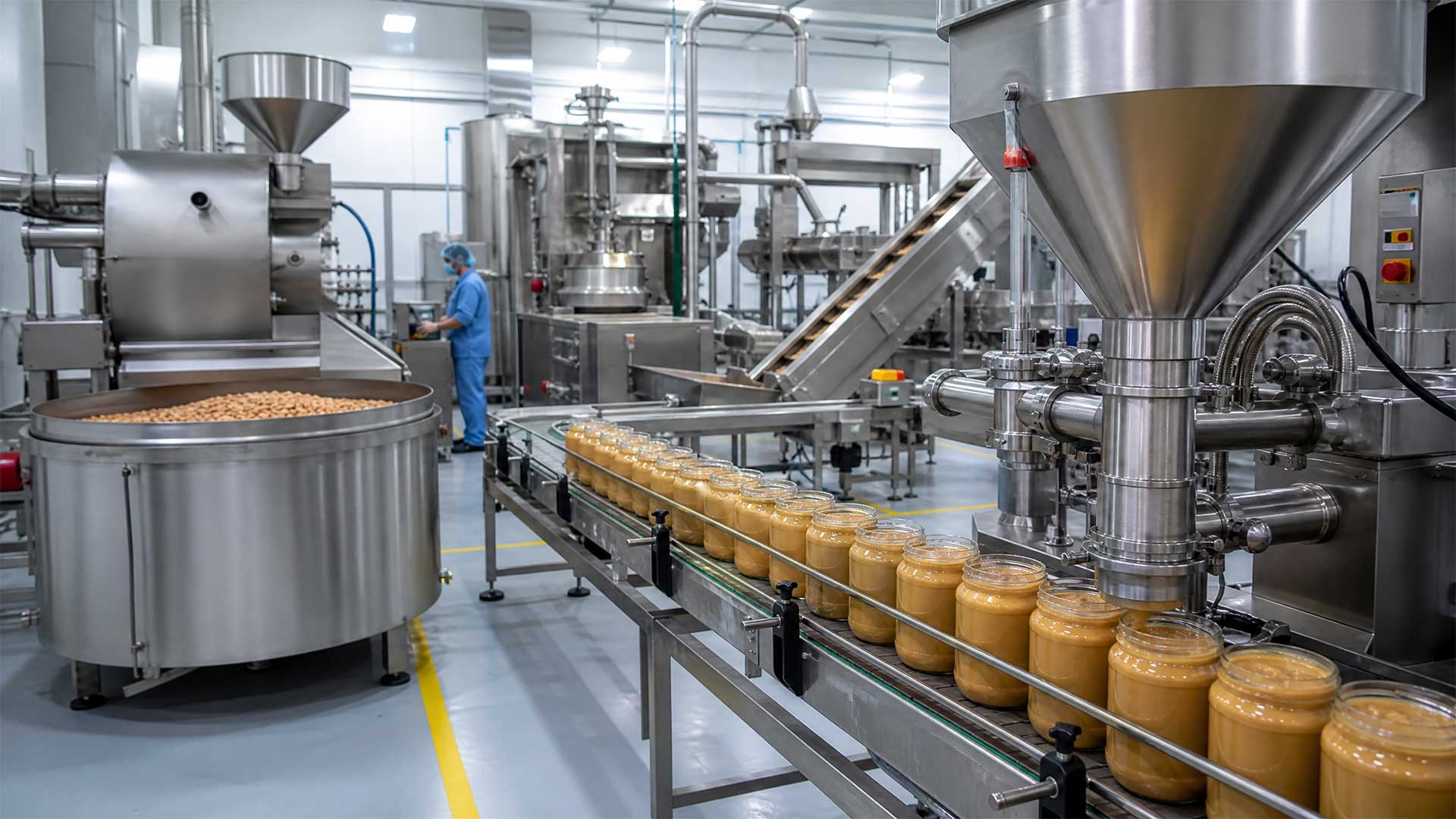
Modern peanut butter manufacturing in India follows a well-defined seven-step process. Each step has specific quality control checkpoints that separate a compliant, export-ready product from generic unregulated output.
1
Groundnut selection and cleaning
Raw groundnuts are sourced from certified growers (Gujarat and Andhra are preferred). The cleaning stage removes stones, dirt, and damaged kernels using vibrating screens and air classifiers. Aflatoxin-prone lots are rejected at incoming QC using rapid test strips before entering the production line.
QC Checkpoint: Aflatoxin rapid test
2
Dry roasting
Cleaned peanuts are roasted in continuous drum roasters at 160–170°C for 25–35 minutes. This is the flavour-defining step — the Maillard reaction generates hundreds of volatile compounds responsible for the characteristic roasted peanut aroma. Under-roasting leaves a raw, grassy flavour; over-roasting creates bitterness and destroys heat-sensitive nutrients.
Critical: Temperature and time control
3
Blanching and de-skinning
Roasted peanuts are cooled, then the red skins are removed either by air blanching (preferred for natural PB) or blanching in water. Skin removal reduces tannin content and improves the final colour and texture of the butter.
Affects: Colour, shelf life, taste
4
Grinding
De-skinned peanuts pass through two-stage grinding — coarse grinding first (creates peanut meal), followed by fine colloid milling (produces the smooth or crunchy texture). For crunchy variants, a portion of coarse-ground peanut pieces is blended back after fine milling. Temperature during grinding is controlled to prevent excessive oil separation and rancidity.
Output: Smooth or crunchy base paste
5
Blending stabilisers, salt, and flavour ingredients
For natural peanut butter: only salt is added. For commercial variants: stabilisers (typically 1–2% partially hydrogenated vegetable oil or mono/diglycerides), sugar, and salt are blended in. Flavoured variants receive cocoa powder, jaggery, fruit extracts, or other flavour compounds at this stage under controlled temperature.
FSSAI regulated: Additive limits apply
6
Cooling, filling, and sealing
The blended peanut butter is cooled to 24–28°C before filling — filling at high temperatures causes excessive air incorporation and lid sealing failures. Filling is done via volumetric or gravimetric fillers into PET or glass jars. Lids are induction sealed to extend shelf life and provide tamper evidence.
QC Checkpoint: Fill weight, seal integrity
7
Quality testing and batch release
Every batch undergoes: aflatoxin testing (ELISA or HPLC method), microbiological testing (Salmonella, E. coli, total plate count), moisture content check, and organoleptic evaluation (flavour, colour, texture). Batches are quarantined until test results are cleared. Certificates of Analysis (CoA) are issued for each lot — essential for export.
Export-critical: CoA with aflatoxin result
Section 05 — Compliance
Peanut Butter Quality Standards — FSSAI, GMP, ISO & US FDA
FSSAI
Food Safety & Standards Authority of India
Mandatory for all food manufacturers in India. FSSAI Schedule I covers permissible additives for peanut butter. Maximum aflatoxin limit: 15 ppb (total). FSSAI licence required for manufacturing, labelling must include nutritional facts per Indian labelling regulations (FSSR 2011).
ISO 22000 / FSSC 22000
Food Safety Management System
ISO 22000 or its more rigorous FSSC 22000 extension is the global benchmark for food safety management. Required by most institutional buyers and major retail chains in India. Essential for European and Middle Eastern export.
GMP
Good Manufacturing Practice
GMP covers facility hygiene, equipment maintenance, pest control, traceability records, and employee training. A prerequisite for any other certification. Audited annually by FSSAI inspectors and third-party buyers.
US FDA
Food & Drug Administration (USA)
Required for exports to the United States. Manufacturers must register their facility with US FDA under the Bioterrorism Act. Peanut butter must meet FDA Standard of Identity (21 CFR 164.150): minimum 90% peanuts. Prior Notice required for all US-bound shipments.
Section 05b — Critical Safety
Aflatoxin Testing in Peanut Butter — Why It Matters
⚠️
Aflatoxin is the most common reason Indian peanut butter is rejected at export borders
Aflatoxins are naturally occurring mycotoxins produced by Aspergillus fungi in improperly stored groundnuts. They are potent liver carcinogens. India’s warm, humid post-harvest storage conditions make groundnuts particularly susceptible. Without rigorous incoming raw material testing and proper storage, aflatoxin can reach hazardous levels — and contaminated batches cannot be detoxified post-production.
| Regulatory Body | Market | Max. Aflatoxin Limit | Specific Type | Test Method |
|---|---|---|---|---|
| FSSAI | India (domestic) | 15 ppb | Total aflatoxins | ELISA / HPLC |
| European Commission | EU | 4 ppb | B1 + B2 + G1 + G2 | HPLC-MS/MS |
| US FDA | USA | 20 ppb | Total aflatoxins | AOAC method |
| Gulf Standards (GSO) | Middle East | 10 ppb | Total aflatoxins | ELISA / HPLC |
| Japan MHLW | Japan | 10 ppb | Total aflatoxins | HPLC |
✦ Specific Example — Real Consequence
EU border rejections due to aflatoxin are documented and public
The EU’s RASFF (Rapid Alert System for Food and Feed) database contains multiple documented rejections of Indian peanut butter and groundnut products for aflatoxin exceeding 4 ppb. The EU limit is nearly 4× stricter than India’s own FSSAI limit. Any manufacturer targeting European export must test to EU standards — using HPLC-MS/MS, not ELISA alone — on every production batch.
Section 06 — Packaging
Packaging Formats & Shelf Life Best Practices
| Format | Typical Use | Material Options | Shelf Life (Sealed) | Export Suitable |
|---|---|---|---|---|
| 340g jar | D2C, trial, gifting | PET, Glass | 12–18 months | Yes (glass preferred) |
| 500g jar | Retail, kirana, gym | PET, HDPE | 18–24 months | Yes |
| 1kg jar | Gym chains, foodservice | PET, HDPE | 18–24 months | Yes |
| Bulk pails (5–20kg) | Bakeries, institutions | HDPE food-grade | 12 months | Requires fumigation cert |
| Sachets (30–50g) | HoReCa, travel, trial | Multi-layer laminate | 6–9 months | Limited (short life) |
Storage best practices — preventing quality degradation
Natural peanut butter is vulnerable to rancidity from oxidised linoleic acid (an unsaturated fat). To maximise shelf life, store finished goods at 15–22°C in dry conditions away from direct sunlight. Induction sealing is non-negotiable for export — it prevents oxygen ingress and acts as tamper evidence. Nitrogen flushing before lid sealing adds a further 3–6 months of oxidative protection for natural variants.
Section 07 — Business Opportunity
Peanut Butter Market Size & Growth in India — 2025 Outlook
India’s peanut butter market is at an inflection point
The category has moved from a niche imported product to a mainstream Indian household staple in less than a decade. Growth is structural, not cyclical.
Flavour trends driving 2024–2025 innovation
The flavoured peanut butter segment is growing at nearly 2× the rate of plain peanut butter in India’s D2C channel. Five flavour directions are generating measurable consumer demand right now:
- Jaggery Peanut Butter
- Dark Chocolate
- Mango
- Cookies & Cream
✦ Sharp Opinion — What’s Underrated
Jaggery peanut butter is the most underrated flavour for Indian export. It tests exceptionally well in the Indian diaspora markets of the UK, UAE, and Canada — where there’s nostalgia for jaggery and growing awareness of peanut butter. Most manufacturers are focused on chocolate; the jaggery gap is wide open.
Section 08 — Business Model
Private Label vs Third-Party vs White Label — Explained
One of the most consistently confusing topics for new peanut butter brand builders in India is the distinction between these three manufacturing models. The confusion is costly — choosing the wrong model at launch can lock you into someone else’s formulation, limit your ability to scale, or create legal IP complications.
| Feature | Private Label | Third-Party Manufacturing | White Label |
|---|---|---|---|
| Formulation ownership | Your brand ✓ | Your brand ✓ | Manufacturer’s ✗ |
| Customisation | Full ✓ | Full ✓ | Limited ~ |
| MOQ (typical) | 500–1,000 kg | 500 kg+ | 100–250 kg |
| Recipe exclusivity | Negotiable ~ | Yes ✓ | No ✗ |
| Speed to market | 4–8 weeks ~ | 8–16 weeks ✗ | 1–2 weeks ✓ |
| Brand differentiation | High ✓ | High ✓ | Low ✗ |
| Best for | Growing D2C brands | Scale-up brands | Testing market fit |
Related Pages
Section 09 — Brand Building
How to Launch Your Own Peanut Butter Brand in India
1
Define your segment and positioning
Are you selling to gym-goers on Instagram? Families through kirana? Health-conscious urban millennials via quick commerce? Your segment determines your formulation type, packaging format, price point, and channel. Most failed peanut butter launches in India tried to be everything — pick one ICP and dominate it before expanding.
2
Choose your manufacturing model
For most first-time founders, private label manufacturing is the right entry point. It lets you test formulations, packaging, and market response without owning production infrastructure. Once you hit consistent monthly volumes above 2,000–3,000 jars, revisit the economics of dedicated manufacturing capacity.
3
Select flavours, packaging, and initial SKUs
Resist launching 8 SKUs at once. The most successful Indian peanut butter D2C brands (Pintola, Alpino, early MuscleBlaze) launched with 2–3 SKUs — typically natural crunchy, natural smooth, and one hero flavour. SKU proliferation before finding product-market fit is a cash drain.
4
Obtain FSSAI licence and business registration
You need: GST registration, FSSAI Central or State licence (depending on turnover), trade licence, and optionally MSME registration. If exporting, add APEDA registration and IEC (Import Export Code) from DGFT. Processing time for FSSAI: 30–60 days.
5
Design branding and FSSAI-compliant labels
Your label must include: product name, ingredient list (descending by weight), nutritional information per 100g and per serving, net weight, batch/lot number, manufacturing and best-before dates, manufacturer’s FSSAI licence number, customer care contact, and allergen declaration. Non-compliant labels are grounds for market withdrawal.
Section 10 — Export
How to Export Peanut Butter from India — Documentation & Compliance
India exports peanut butter to over 40 countries. The USA, UAE, UK, Germany, Netherlands, Australia, and Singapore are the top destinations. The documentation requirements differ significantly by destination market.
APEDA Registration → IEC from DGFT → Phytosanitary Cert → Aflatoxin Test Report → CoA (each batch) → FDA Registration (USA) → Prior Notice (USA)
| Export Destination | Key Regulatory Body | Aflatoxin Limit | Special Requirements | HS Code |
|---|---|---|---|---|
| USA | US FDA | 20 ppb | FDA facility registration, Prior Notice | 2008.11.10 |
| European Union | EFSA / EC | 4 ppb (B1) | HPLC aflatoxin cert, EU labelling compliant | 2008.11.10 |
| UAE / GCC | GSO / ESMA | 10 ppb | Halal cert, Arabic label | 2008.11.10 |
| UK | FSA (post-Brexit) | 4 ppb | UK labelling compliant (UKCA equivalent) | 2008.11.10 |
| Australia | FSANZ | 15 ppb | BICON permit for peanut products | 2008.11.10 |
Section 11 — Decision Tool
Choosing the Right Peanut Butter Manufacturer — 10-Point Checklist
Use this checklist when evaluating any peanut butter manufacturer in India for private label, contract manufacturing, or export supply.
- FSSAI licence valid and current — verify the licence number on the FSSAI portal directly; don’t rely on a PDF copy.
- ISO 22000 or FSSC 22000 certified — ask for the current certificate with expiry date and certifying body name.
- Batch-level aflatoxin test certificates — every batch should have an aflatoxin result from an NABL-accredited lab; demand a sample CoA before signing.
- Flexible MOQ for private label — confirm the minimum order per SKU and whether trial batches are available at 200–300 kg.
- In-house R&D / flavour development — if you want jaggery, chocolate, or custom variants, the manufacturer must have a formulation team; not all do.
- Export track record — ask for references from existing export clients and the markets they supply; a domestic-only manufacturer is a higher risk for export-quality consistency.
- Packaging options and customisation — verify they can supply your chosen jar format, induction seal, and accept your label specifications.
- Lead time clarity — get confirmed production and dispatch lead times in writing; vague answers are a red flag.
- Facility audit or visit policy — a reputable manufacturer welcomes scheduled audits; refusal or excessive delay is a warning sign.
- Traceability system — they should be able to trace any batch back to the incoming raw material lot; ask how far back their records go.
Ready to Find the Right Manufacturer?
Explore verified peanut butter manufacturers in India — FSSAI certified, export-ready, private label capable.
Section 12 — Quick Answers
Frequently Asked Questions
What is the minimum order quantity for peanut butter manufacturing in India?
Most private label peanut butter manufacturers in India offer MOQs starting at 500–1,000 kg per SKU. Some manufacturers accept 200–300 kg pilot runs for new brand launches, particularly for flavoured or speciality variants. Always confirm MOQ per SKU, not per total order.
What certifications should a peanut butter manufacturer hold?
At minimum: a valid FSSAI manufacturing licence and GMP compliance. For institutional buyers and retail chains: ISO 22000 or FSSC 22000. For USA export: US FDA facility registration. For European export: additional aflatoxin testing protocols to EU limits (4 ppb). For Middle East: Halal certification may be required by individual buyers.
What is the shelf life of natural vs commercial peanut butter?
Natural peanut butter (no stabilisers) has a shelf life of 6–12 months, stored at room temperature away from direct light. Once opened, refrigerate and consume within 4–6 weeks. Commercial peanut butter with stabilisers and hydrogenated oils lasts 18–24 months unopened. Induction sealing and nitrogen flushing extend shelf life for both variants.
Can I export peanut butter from India to the USA or EU?
Yes — India is a significant exporter of peanut butter. For the USA: your manufacturer’s facility must be registered with US FDA, and you need APEDA registration, IEC, phytosanitary certificates, and a Prior Notice before each shipment. For the EU: you need HPLC-method aflatoxin test certificates showing results below 4 ppb, and product labels must comply with EU Regulation 1169/2011 on food information.
What is the difference between private label and white label peanut butter?
Private label means the manufacturer produces a formulation that is branded exclusively under your brand name. You can customise the recipe, flavour, and packaging. White label means you put your brand on a standard product the manufacturer produces identically for multiple buyers — no recipe exclusivity. Private label offers stronger differentiation but requires higher MOQs; white label offers faster market entry at lower minimum quantities.
How much does it cost to start a peanut butter brand in India?
For a private label launch with 2–3 SKUs at 500 kg MOQ each, initial investment typically falls in the ₹8–15 lakh range, covering raw material cost, packaging design, FSSAI and regulatory compliance, initial inventory, and basic digital marketing setup. This excludes ongoing working capital.